Collision Avoidance of Mobile Robots
- Mobile robot collisions gum up entire production schedules - greatly slow down manufacturing and delivery deadlines – and costs skyrocket through the roof.
- MOBILE CO-ROBOTICS autonomous collision-avoidance patents show how self-managing robotic machines can cooperate with each other through on-the-fly localization and identification, even in a crowded or chaotic industrial environment - which is very often the case.
- MOBILE CO-ROBOTICS autonomous collision-avoidance patents are therefore a godsend offering huge value to major manufacturers – as well as to companies with large-scale packaging and 7-days-a-week shipping requirements.
- In a brutally super-competitive business environment where multi-megabillion dollar companies fight tooth and nail for market share, MOBILE CO-ROBOTICS collision-avoidance patents = money in the bank.
Hardware compatibility. The autonomous solutions disclosed herein for MOBILE CO-ROBOTICS patents are fully backward-compatible with existing hardware equipment, and are forward-compatible with proposed 6G Standards.
|
|
MOBILE CO-ROBOTICS is a revolutionary way for autonomous mobile robots to coordinate their actions. Currently, autonomous mobile robots (AMRs) cannot communicate with each other, robot-to-robot, because they have no reliable way to identify each other. If they can't communicate, they can't cooperate. The inevitable result: impeded warehouse operations and slower delivery to the customer.
MOBILE CO-ROBOTICS is a fast and reliable solution. When a robot needs to initiate cooperation with another robot, it first broadcasts a brief, low-power wireless message indicating its wireless address, while simultaneously flashing its lights. The other robot observes the flashes while receiving the wireless message, and reflexively does the same thing. Both robots then know how to communicate with each other, and they begin cooperating to solve the problem. In short, when robots are able to associate a particular wireless address with a particular robot, only then can they begin to communicate, robot-to-robot, and thereby solve whatever problem has arisen. The entire process takes only one millisecond.
For the first time ever, autonomous mobile robots can initiate communication with a particular other robot, and thereby initiate cooperation to solve problems together. Solving problems together is vastly more effective than trying to do it alone, as is currently done. The key to cooperative problem solving is self-initiated, autonomous, mutual robot identification: MOBILE CO-ROBOTICS.
APPLICATIONS
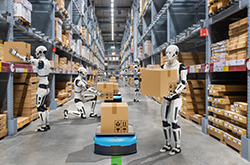
Robot-to-robot coordination is essential wherever swarms of independently-moving robots are working in the same area. Because the robots are focused solely on their own task, they repeatedly get in each other's way. This results in frequent small obstructions and occasional large traffic jams, unavoidably slowing down warehouse operations. In addition, they are limited to a very slow speed when moving among other robots. This is a consequence of treating the other robots as mere objects, never attempting to communicate directly with them. Actual collisions, although rare, result in a costly mess and probably a shutdown of the entire section.
The core problem is that the robots cannot identify each other, and therefore cannot communicate with each other, and therefore cannot coordinate with each other. Some robots have sequence numbers or other indicia, but these are often obscured or in shadow or smudged, and in every case, the visual interpretation requires a substantial, error-prone software package. Visual identification wastes excessive time, even under the best visual conditions - and yet they still get it wrong much of the time!
MOBILE CO-ROBOTICS is simpler, faster, and fool-proof. Each robot that wants to communicate with another robot simply transmits a light pulse and a short wireless signal simultaneously. The other robot reflexively does the same. Instantly, they both begin communicating and cooperating. Instantly, the problem is solved, and warehouse operations can proceed at full pace.
To consider some specific examples:
(1) A first robot needs to move in a certain direction, but a second robot is blocking its path. So they instantly identify each other with the MOBILE CO-ROBOTICS procedure, enabling cooperative communication. The first robot then sends a message like "R139, move 1 meter south". The second robot moves aside, thereby allowing the first robot to continue on its way. Time lost: less than one millisecond. Without MOBILE CO-ROBOTICS, the first robot would have to wait stupidly until the second robot decides to move on its own initiative - an unlimited delay.
(2) As a second example, robot traffic jams routinely form at choke points such as packing stations. With MOBILE CO-ROBOTICS, the robots can actively mitigate the traffic jams through cooperative actions, thereby restoring smooth warehouse flow.
(3) One thing that is not done in today's warehouses, but would result in major improvements if it were possible, is spontaneous ad-hoc cooperation between different types of robots. For example, a big robot carrying a small item could transfer the item to a more suitable small robot for delivery, and then go back for a heavier pickup. But that would require communication between them, which is impossible without spontaneous mutual identification. With MOBILE CO-ROBOTICS, however, the task is simple; they simply agree to the transfer, and it's done!
(4) You will find lots of other examples of robot-robot cooperation enabled by MOBILE CO-ROBOTICS, all of which will lead to enhanced warehouse operations. None of these solutions would be possible unless the robots know each other's wireless address, which they don't. Every application example succeeds with MOBILE CO-ROBOTICS, and fails otherwise.
CONCLUSION
MOBILE CO-ROBOTICS is a gateway to advanced robot-robot cooperation, in swarm applications such as warehouses. By enabling the mobile robots to identify, and hence communicate with, other robots in proximity, MOBILE CO-ROBOTICS opens an unlimited potential for process acceleration, impediment avoidance, and overall operational improvements. The result is faster delivery and greater satisfaction for the customer; and for the warehouse - faster and smoother predictable operations, with reduced costs overall.
Implementation of MOBILE CO-ROBOTICS is simple, quick, and essentially cost-free. This update provides immediate improvements, as myriad small impediments can now be avoided. Much greater benefits, however, will show up later, after the robots have developed their own novel and highly effective strategies for improving their assigned tasks.
We are on the verge of spontaneous cooperation among autonomous mobile robots. What an exciting time in the robot business! There is so much more to this opportunity.
Please contact me for any questions you may have, as it would be a pleasure to interface with you. Most likely, we can devise some very important applications together which would be assigned to your company.
Thank you!
David E. Newman, PhD
VP and Chief Scientist
UltraLogic 6G
760-809-7601 (pacific time)
david.newman@UltraLogic6G.com
|
|
- To download a large ZIP file containing the entire portfolio, click here.
ISSUED PATENTS AND APPLICATIONS FOR
MOBILE CO-ROBOTICS
- 12,145,263
Robot Cooperation by Simultaneous Infrared and 5G/6G Wireless Signals - November 14, 2024
Cooperation between robots, or between humans and robots, requires that each entity know the location of each other cooperating entity. Disclosed is a method for robots to localize and identify each other using simultaneous IR and wireless signals.
Result: SAFE COOPERATION BETWEEN ROBOTS AND HUMANS.
- 11,752,620
Cooperation Among Mobile Robots Using 5G/6G Communications - September 12, 2023Fixed and mobile robots require specialized communication to identify themselves and localize other robots in real-time. Disclosed are systems and methods enabling a very wide range of robotic systems to communicate specifically with each other, for problem avoidance and productivity enhancement.
Result: RAPID COORDINATION OF AUTONOMOUS ROBOTS. - 11,554,479
Autonomous Navigation and Collaboration of Mobile Robots in 5G/6G - January 17, 2023Robots are expected to be the basis for the 21st-century economy in developed countries, but an unsolved problem remains how to manage autonomous mobile devices and avoid collisions. Here we present methods for mobile robots to identify and localize each other, and collaborate in solving production problems.
Result: COLLISIONS AVOIDED, WORKFLOW ACCELERATED. - 11,458,615
Collision Avoidance of Mobile Robots - October 4, 2022In a busy automated factory, managing a multitude of single-task mobile devices in motion is an unsolved problem. Here we show how the mobile devices can automatically communicate, localize each other, and coordinate to avoid problems such as collisions and interference.
Result: FASTER, SMOOTHER FACTORY OPERATIONS. - 10,814,474
Identification and Localization of Mobile Robots - October 27, 2020
Mobile robots in a busy industrial site must coordinate their actions to avoid interfering with each other. This Patent shows how each robot can use coded light pulses and simultaneous wireless messages to identify themselves. The robots can then communicate directly while in motion, for better coordination and management.
Result: IMPROVED PRODUCTION EFFICIENCY.
 |
 |
 |
 |
 |
 |
 |
 |
 |
|
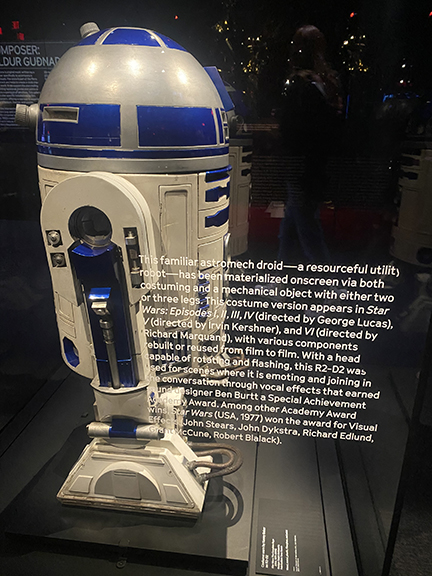
The Original 'MOBILE ROBOT' R2D2 |
 |
 |
AUTONOMOUS
MOBILE CO-ROBOTICS
MOBILE CO-ROBOTICS

|
|
We offer to sell our
MOBILE CO-ROBOTICS
autonomous patent portfolio
to a
major robotics company.
